
We Asked Chefs, Sommeliers, and Artisans How to Choose Olive Oil
FOODFEATUREDTASTING NOTES
Essence & Style Team
4/2/20267 min read
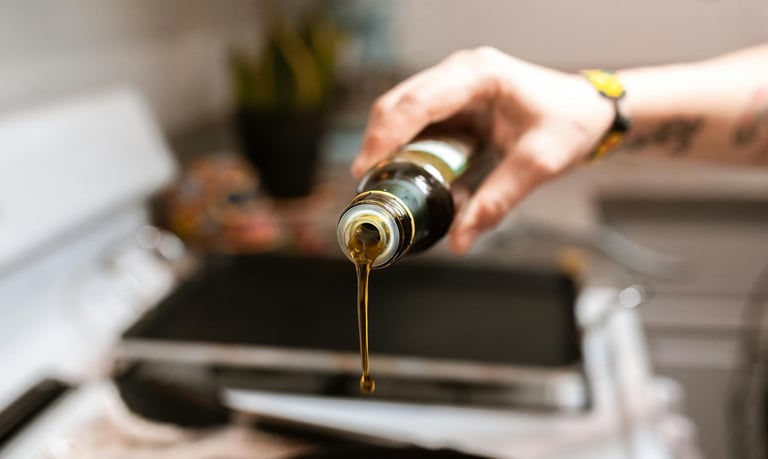
From harvest and production to flavor and texture, experts explain what makes an olive oil exceptional and how thoughtful choices elevate every dish.
There is a moment in the kitchen when olive oil stops being a background ingredient and becomes the decision. A final pour over vegetables, a quiet finish to a dish, a detail that either lifts everything or leaves it flat. It is subtle, but it is rarely accidental, especially in professional kitchens where small choices carry weight.
Ask chefs, sommeliers, and food producers what they look for in extra virgin olive oil, and their answers rarely sound identical, but they tend to circle the same ideas. Not rigid rules, but shared instincts shaped by experience. Over time, those instincts form a kind of quiet standard, one that values freshness, clarity, and a sense that the oil still has something to say.
Freshness is not optional
Freshness is where nearly all of them begin, and it is often the most misunderstood part of buying olive oil. Many people treat it like a shelf-stable pantry staple, something that can sit for years without consequence, but professionals know better.
“Many consumers assume that olive oil stays good forever, but it can definitely spoil,” says Brandon Blackwell, co-founder of Elysian Events Catering in New Orleans. Even in a high-volume kitchen where olive oil is used daily, that awareness shapes how he buys and stores it. “We still make sure to pick oil that has been recently bottled,” he explains, noting that packaging and storage are just as important as sourcing. “If your olive oil is spoiled, it ultimately won’t matter that it’s high-quality.”
That perspective is echoed by Giovanni Dagostino, the co-founder of The Italian On Tour and an olive oil sommelier, who has spent more than two decades sourcing and evaluating oils across different countries. For him, time is non-negotiable, and freshness has a clear window. “Always buy extra virgin olive oil from the current production year if you can,” he says. “Extra virgin olive oil loses its qualities over time and lasts 18 to 24 months at the most.”
Taken together, their views point to a simple but often overlooked truth. Olive oil is a fresh product, and its quality declines quietly with time, even when stored well. The difference between a vibrant oil and a tired one becomes obvious once you know what to look for.
Flavor is structure, not just taste
What defines a great oil at its peak is something you notice immediately, even if you cannot always name it. There is a sense of movement on the palate, a beginning, middle, and finish that gives the oil dimension.
Dagostino looks for oils that are “fruity and slightly spicy,” qualities that distinguish true extra virgin olive oil from flatter, more neutral alternatives. “You never want an oil that has a taste which is too flat and resembles a seed oil,” he adds. That liveliness, the brightness followed by a gentle bitterness and a peppery finish, signals that the oil has been handled with care from harvest through extraction.
Justin Meadows, chef and owner of Block & Rooster Provisions, always looks for those same flavor notes. “Good extra virgin olive oil should have fruitiness, bitterness, and a peppery finish,” he says. Those elements, when in harmony, point to proper processing and a higher concentration of polyphenols, the compounds responsible for both flavor and many of olive oil’s widely discussed benefits.
Matching the oil to the dish
In the kitchen, that flavor is not just appreciated; it is considered in context. The same oil that works beautifully in one dish can feel out of place in another, which is why chefs tend to think about olive oil in terms of how it will behave, not just how it tastes on its own.
Blackwell’s menus often lean toward seafood and lighter dishes, which naturally call for restraint. “We offer many seafood and light hors d’oeuvres options, making milder olive oil the best option for our service,” he says. A more delicate oil allows those ingredients to remain the focus, rather than competing for attention.
At the same time, he is careful to point out that there is no single standard. “It’s an important and often overlooked detail to match the flavor profile of your oil to the type of cuisine you're using it for.” In richer dishes, a more robust oil can add structure and contrast, bringing balance rather than excess.
Beyond savory: when olive oil lends its flavor to chocolate
That idea, that olive oil should suit the dish rather than simply exist in it, carries across different corners of the food world. In some cases, it moves beyond support and becomes central to the flavor itself.
Matt Cross, co-founder of Harvest Chocolate, approaches olive oil with the same level of care he brings to cacao. Both are shaped by origin, process, and intention, and both have the ability to shift the final result in subtle but meaningful ways. “We’re looking for intention, quality, and a clear point of view from the producer,” he says.
In his olive oil dark chocolate, the right oil becomes part of the structure of the flavor. “It adds a deep richness and a sense of luxury that cocoa butter alone can’t deliver,” he explains, either lifting lighter, fruit-forward notes or reinforcing deeper, more indulgent ones. It is not simply added. It is integrated.
Origin, transparency, and what the label reveals
If flavor tells you what an oil is, how it is made begins to explain why it tastes that way. For many professionals, that understanding starts with origin, though not in a simplistic or status-driven sense.
Meadows points out that different regions naturally produce different profiles. “Italian oils often lean grassy and peppery, Spanish oils can be bold and robust, and Greek oils are frequently smooth and fruit-forward,” he says. These are not rules so much as tendencies, shaped by climate, soil, and olive varietals.
Sara Jimenez, a wine and olive oil sommelier behind Somm in the City, looks beyond region to traceability. “I look for single-origin olives,” she explains. “Even if the oil is a blend of cultivars, I want transparency that all olives are sourced from the same place.” That clarity allows for consistency and a deeper understanding of what is in the bottle.
She also emphasizes harvest timing as a defining factor. “Olive oil is a fresh product, not a shelf-stable commodity,” she says. Earlier harvests, often from greener olives, tend to produce oils with “more bitterness and pungency, and greater oxidative stability,” all of which point to higher polyphenol levels and a longer window of peak flavor.
Why packaging and storage matter more than you think
Still, origin alone does not guarantee quality, and several experts are careful to make that distinction. How the oil is handled after harvest plays an equally important role in preserving what makes it good in the first place.
Chef James Barry, who has spent more than two decades in professional kitchens and founded seasoning company Pluck, sees origin as secondary to process. “Exceptional extra virgin olive oils can come from Greece, Italy, Spain, California, and beyond,” he says. “What matters most is how the oil is produced, stored, and packaged.”
That attention to detail brings the conversation, almost inevitably, to packaging. Across the board, dark glass or tins are considered essential for protecting the oil from light exposure.
“Always choose a dark glass bottle or a tin and never a plastic bottle,” Dagostino advises, pointing to the damaging effects of light and UV exposure. Barry reinforces that standard in more direct terms. “If it isn’t glass, it isn’t quality,” he says, noting that oils can absorb contaminants and degrade more quickly when stored improperly. Jimenez also agrees, “I look for dark glass bottles—green, black, blue, or fully matte. Clear bottles allow light exposure, which accelerates oxidation, especially in a kitchen environment.”
Blackwell adds that storage continues to matter even after purchase. Olive oil should be kept in a cool, dark place, away from heat sources like stoves or direct sunlight. Without those precautions, even a well-made oil can deteriorate faster than expected.
Looking at the numbers: acidity, polyphenols, and trust
Beyond taste and sourcing, some experts are also paying closer attention to measurable indicators that are not always visible on the surface. These details offer another way to understand quality, particularly in a market where labeling can be inconsistent.
Michael Kladis, founder of Soma Grove, highlights acidity and polyphenol content as key markers. “The international standard of acidity to qualify as ‘extra virgin’ is 0.8%,” he explains, noting that lower acidity often reflects fresher, better-processed oil. Polyphenols, he adds, are closely tied to both flavor and function.
“Polyphenols are natural compounds that provide antioxidant and anti-inflammatory properties,” he says. Higher levels tend to correlate with the bitterness and pepperiness that professionals often look for, reinforcing the connection between taste and composition.
He also points to a broader issue. In markets with less stringent regulation, oils labeled “extra virgin” may not always meet that standard, making transparency and verification more important for those who want consistency.
Dagostino expresses a similar concern in more direct terms. “Extra virgin is one of the most adulterated food products on the market,” he says, particularly among large-scale producers where volume and price can take priority over quality.
In the end, it comes back to taste
For all the discussion around sourcing, chemistry, and labeling, olive oil ultimately returns to something more immediate. It is something you experience directly, and often instinctively.
Barry, who has also cooked for A-listers like Tom Cruise and George Clooney, encourages cooks to rely on their senses. A well-made oil, he says, often carries a “bold, peppery or slightly bitter taste,” and in some cases a slight cloudiness, particularly in fresher oils that have undergone minimal filtration. These qualities are not flaws but indicators of a less processed, more intact product.
Jimenez reinforces that point from a sensory perspective. A true extra virgin olive oil should show fruitiness without defects, with no rancid, musty, or greasy notes. Clean, vibrant flavor is the clearest sign that the oil has been handled correctly at every stage.
Taken together, these perspectives reveal a shared understanding that goes beyond any single metric. The best extra virgin olive oils are fresh, carefully produced, and thoughtfully chosen. They reflect where they come from without being defined by it alone, and they hold their place in a dish without overwhelming it.
They feel alive, carrying with them the work of the grower, the timing of the harvest, and the decisions made along the way. And when they are right, they do something quietly transformative, turning even the simplest dish into something worth remembering.